Varaaz Arts — Blog
The Line and Its Reflection — Where Form Begins
Two Fridays ago, we sat with a single dot.
Last Friday, we watched that dot begin to move.
In this post
- Why a line is the first sign of direction and intention — the moment stillness starts to move
- How the shapes your hand naturally draws (petals, waves, straight lines, crosses) mirror your emotions and memories
- Why drawing a line and its mirror reflection calms the mind — and what the science says about it
- How balance, not drama, is what quietly creates beauty and form
More Than Art — A Mirror for the Mind
Before we even picked up a pen, I want to say something I say at the start of every session: a mandala is not really an art form. It's a psychological tool. A way of aligning yourself — with your thoughts, your emotions, your own nature — using nothing but shape and repetition.
That idea became very real once we started drawing the line.
What Is a Line, Really?
A dot just sits there. It has no direction, no destination. It simply is.
The second a dot moves, it stops being "just a point" and becomes something with intention — a direction, a decision, a beginning. That's what a line is. Energy, made visible.
But here's what surprised even the group last Friday: not every line moves the same way. And how it moves says something. In Sanskrit, we call it Reka.
Your Line Knows What You're Feeling
We drew freely — no rules, just letting the hand move — and then looked at what came out. And a pattern showed up almost immediately.
Some hands drew soft, curved lines that opened out like petals. Those shapes, again and again, trace back to a connection with nature — as if the hand remembers gardens, leaves, growth, without being told to.
Other hands drew rolling, repeating waves. And nearly every time, that shape carried a memory of water — a childhood by the sea, a river, rain against a window. The line wasn't random. It was carrying something.
Straight lines. Crosses. Curves. Each one is quietly a mirror of where your mind is standing right now — calm, searching, anchored, restless. The page doesn't lie. It just shows you what you already carry.
Reflection — The Line's Silent Partner
Here's the part most people miss: a single line, on its own, can feel unsteady. Off-balance. Like a sentence with no full stop.
But draw that same line — and then draw its mirror image on the other side — and something shifts immediately. The whole thing settles. It feels calm. Complete.
This isn't just an art trick, and it isn't just tradition either. There's real science behind it: when your hand draws a mirrored, symmetrical pattern, it engages both sides of the brain together, and that kind of balanced, repetitive movement has a genuinely calming effect on the nervous system. Mirroring on paper seems to create a small echo of mirroring inside you.
A single line needs its reflection to become whole. So, it turns out, do we.
How Balance Creates Beauty
Once you have a line and its reflection sitting together, you don't just have two lines anymore — you have a shape. A pattern. The very beginning of form.
This is exactly how every mandala is built. Not from chaos, not from randomness — but from one small, deliberate act (a line) meeting its own balance (a reflection), again and again, until a whole, beautiful pattern emerges.
It's a quiet reminder: beauty isn't usually made from something dramatic. It's made from small, balanced, repeated acts of intention.
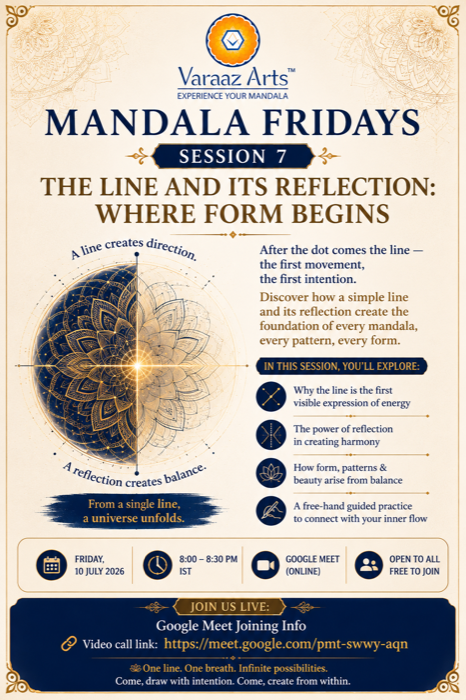
"A line creates direction. A reflection creates balance.
From a single line, a universe unfolds."
Closing
You don't need to be an artist to understand this. You don't need to know sacred geometry, or psychology, or neuroscience.
You just need a pen, a page, and a willingness to draw one honest line — and see what it tells you, and what answers it back.
Join Us
Experience This Live — Mandala Fridays
Every Friday, 8:00 PM – 8:30 PM. Free. Online.
We draw together, explore the wisdom, and come back to centre.