Varaaz Arts — Blog
The Science Behind Mandala Art
Many people tell me after a mandala session — "I feel so calm. I don't know why, but something feels different."
And then they smile and ask, "Is this all in my head?"
Yes. Exactly. It is in your head. And that is precisely why it works.
Let me explain what actually happens inside your brain when you draw a mandala. No complicated science — just simple truth.
What Drawing a Mandala Does to Your Brain
It uses both sides of your brain at the same time
The left side of your brain likes order — counting petals, following steps, being precise. The right side loves creativity — feeling where the line should go, enjoying the beauty of the whole. Mandala drawing uses both together. That is rare. And that is why it feels so complete.
Your body goes into rest mode
When you draw a mandala slowly and carefully, your heart rate comes down. Your breathing slows. The stress hormone in your body — cortisol — begins to reduce. I see this happen with my therapy clients within just ten minutes of drawing. It is not imagination. It is your body responding.
Time disappears — in a good way
There is a state called "flow" — when you are fully absorbed in something, not bored, not stressed, just completely present. Mandala drawing puts you in that state. You look up and an hour has passed. That is not distraction. That is deep rest.
Your brain sees order and relaxes
Our brain is always looking for patterns and order. When life feels messy or overwhelming, the brain stays on alert. But when you draw a mandala — and watch something beautiful grow from a single dot — your brain says "order is here." And it calms down.
Colour speaks to your feelings, not your thoughts
Did you know that colour reaches the emotional part of your brain before your thinking brain even notices it? Blue and purple create quiet. Gold and orange feel warm and energising. Green feels balanced. When I teach colour in my workshops, I am not teaching art. I am teaching people to understand their own feelings.
The circle itself makes you feel safe
The famous psychologist Carl Jung noticed that people under stress naturally start drawing circles — without being told to. The circle has no sharp edges, no corners. It is complete. It is whole. When you sit inside a circle and draw, something in you relaxes. You feel contained. You feel safe.
The 4 Steps of Drawing a Mandala — and What Each One Does for Your Mind
In ancient India, this was called Sristi Krama — The Order of Creation. Every step is not just about art. Each step trains your mind.
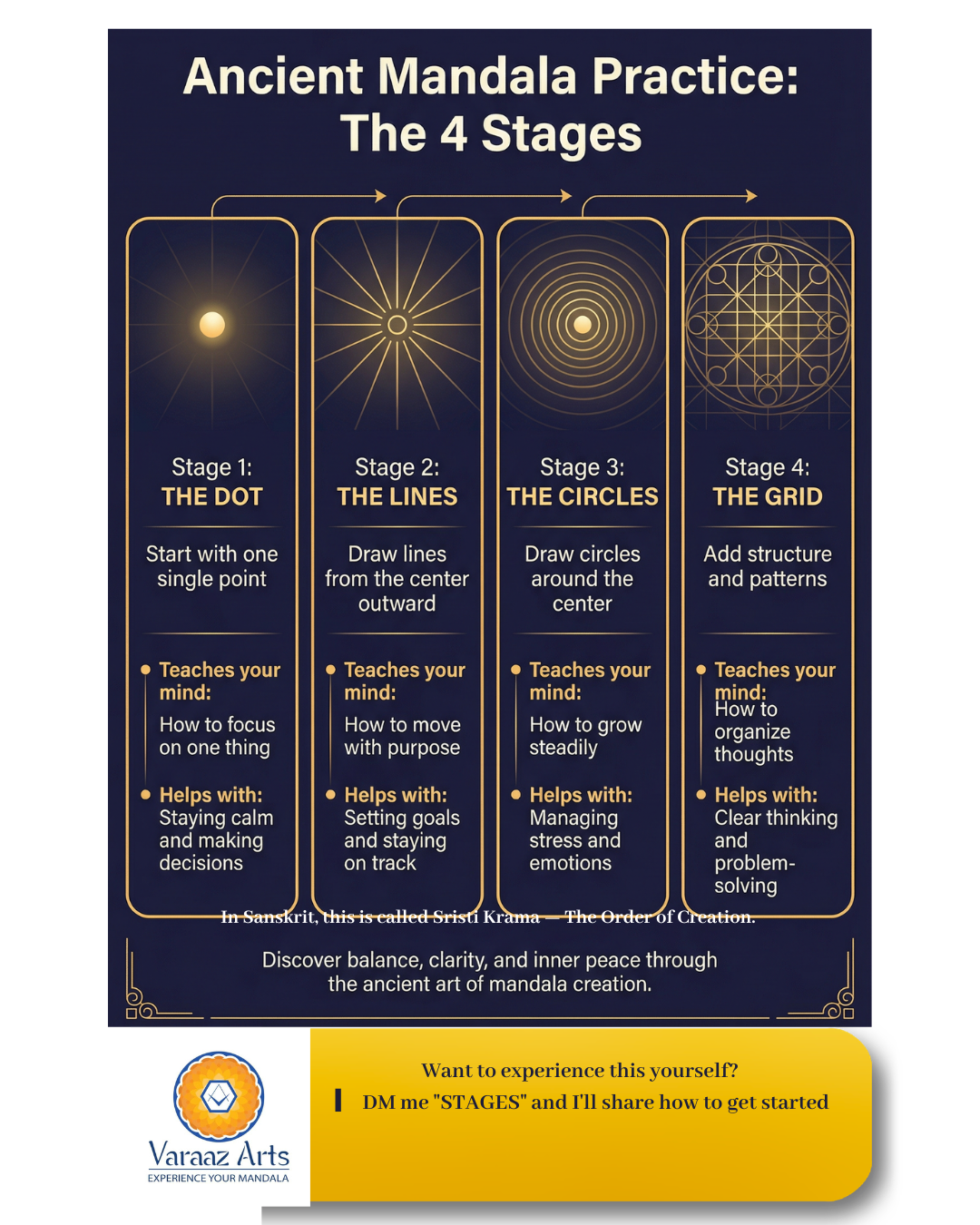
Step 1: The Dot — Learn to focus
You place one single point at the centre. That's it. In a world where our attention is pulled in ten directions, placing one dot and staying with it is already a practice in calm and focus.
Step 2: The Lines — Learn to move with purpose
Lines go outward from the centre. Your hand moves with direction. Your mind learns what it feels like to have a clear starting point and move forward from it.
Step 3: The Circles — Learn to grow steadily
You draw circles outward, one layer at a time. No rushing. No jumping ahead. This is where stress and emotions begin to settle — because you are practising patience with your own hands.
Step 4: The Grid — Learn to organise
Structure and pattern come in. Your mind learns to hold many things in order — without confusion, without chaos. Clear thinking follows naturally.
By the time a mandala is complete, your mind has practised four things — focus, purpose, patience, and clarity. All in one sitting.
What Our Ancestors Already Knew
Long before science had words for any of this, the ancient Vedic tradition already understood it.
The word "mandala" in Sanskrit means "circle" — or more beautifully — "that which contains the essence."
They used mandalas not as decoration, but as a tool. A tool to bring the distracted mind back to stillness. A tool that worked not through belief, but through the simple act of drawing.
What modern science is discovering now, they already knew thousands of years ago.
"Where Sacred Geometry meets Art Therapy, the mind finds balance and the soul remembers itself."
What This Means for You
You do not need to be an artist. You do not need any experience. You do not need to believe in anything.
You just need a pen, a circle, and a few quiet minutes.
Every kind of person has sat with me and drawn a mandala — busy professionals, worried parents, teenagers who said they "can't draw," grandmothers who hadn't held a brush in years. Every single one of them felt the shift.
The mind slows. The hand moves. And something that felt knotted inside begins to loosen.
That is the science. That is the art. And in this practice, they are the same thing.
Start Your Practice
Want to Begin Your Own Mandala Practice?
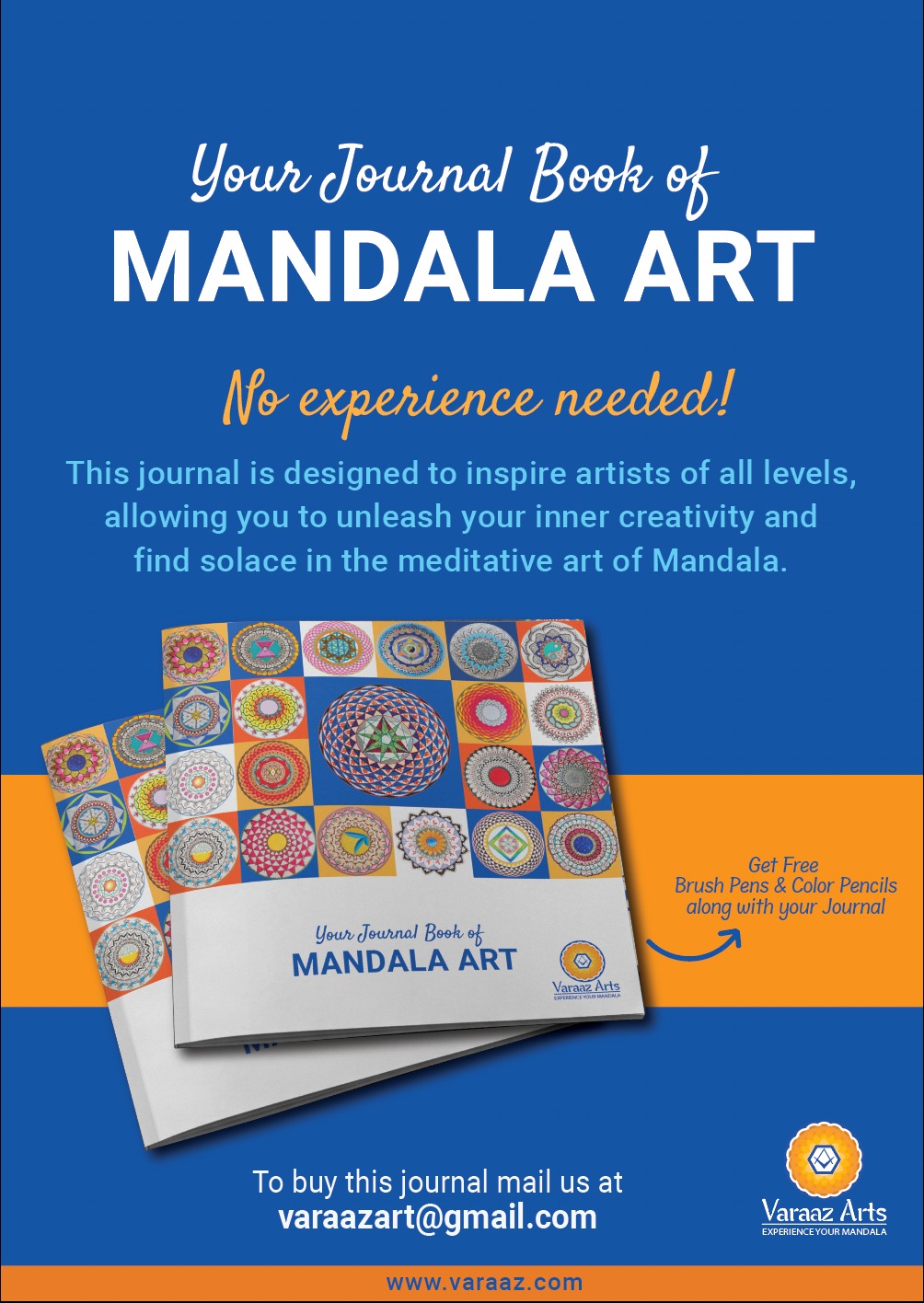
Varalakshmi has created a Mandala Art Journal — made for complete beginners. No experience needed.
Digital Edition — ₹199
Download it instantly and start today. Print at home and begin your practice right away.
Buy the PDFPremium Physical Journal — ₹1,650
Printed on special leak-proof sheets — your colours stay bright and clean, and never bleed through. When your pages are complete, they look beautiful enough to frame and hang on your wall.
Every physical copy comes with:
- Your Mandala Art Journal — printed and ready to use
- Free Brush Pens
- Free Colour Pencils
Everything you need to begin — delivered to you.
Email to Order → admin@varaaz.com