Varaaz Arts — Blog
Svabhava — What Your Body Feels When You Draw a Mandala
Have you ever finished drawing a mandala and thought —
Something feels different. I don't know what changed. But something did.
That something is not in your imagination.
It is in your body.
And I want to tell you what actually happens — inside you — when your hand picks up a pen and begins to draw.
Both Sides of You Finally Work Together
Your brain has two sides.
One side likes order. It counts the petals. Keeps the spacing even. Follows the steps.
The other side feels. It knows when a line looks beautiful. It enjoys colour. It flows.
In most things we do — one side leads and the other waits.
When you draw a mandala — both sides work at the same time.
The counting and the creating. The structure and the feeling.
Together.
This is rare. And this is why drawing a mandala feels like relief.
Not just rest — but a kind of wholeness.
The Tension in Your Body Begins to Leave
When we are stressed — the body holds.
Shoulders. Jaw. Hands. Chest.
We hold without knowing we are holding.
When you sit and begin to draw — slowly, carefully —
your breath deepens on its own.
Your grip softens.
Your shoulders begin to drop.
You didn't try to relax.
Your body simply stopped holding.
The act of drawing — the gentle repetition of line after line, circle after circle —
tells your body that it is safe now.
That it can let go.
Within ten minutes of drawing, I see this happen with every person who sits with me.
The body knows before the mind agrees.
Your Body Relaxes When It Sees Order
We live in a world that often feels unpredictable.
And when life feels that way — the body stays on alert.
Watching. Waiting. Holding.
But when you sit with a blank page and begin —
one dot at the centre,
one line moving outward,
one circle growing,
one petal appearing —
your body watches something beautiful grow from almost nothing.
And something in it settles.
Order is here. I can rest.
You didn't solve a problem.
You didn't fix anything outside.
But your body felt order with your own eyes.
And that was enough.
The Circle Holds You
Carl Jung — a great psychologist — noticed something across his lifetime of work.
People under stress, from every culture, in every century —
naturally draw circles.
Without being asked.
Without knowing why.
The circle has no sharp edges. No corners. No beginning or end.
It is complete. It is whole.
When you sit within a circular form and draw —
something ancient in you recognises it.
This is safe. This is whole. I belong here.
Your body responds to the geometry of the mandala.
Not because of belief.
Because of what you are made of.
"Science did not discover something new about mandalas.
It discovered something true about you."
The Gita Already Knew This
Long before science had words for any of this —
the Vedic teachers had already mapped it.
The Gita gives an eight-step process to stop the ripples of emotions and quieten the mind.
These eight steps move from the outside world to the very centre of your being.
How you live in the world. How you hold your body. How you breathe.
How your attention gathers inward. How the mind becomes still.
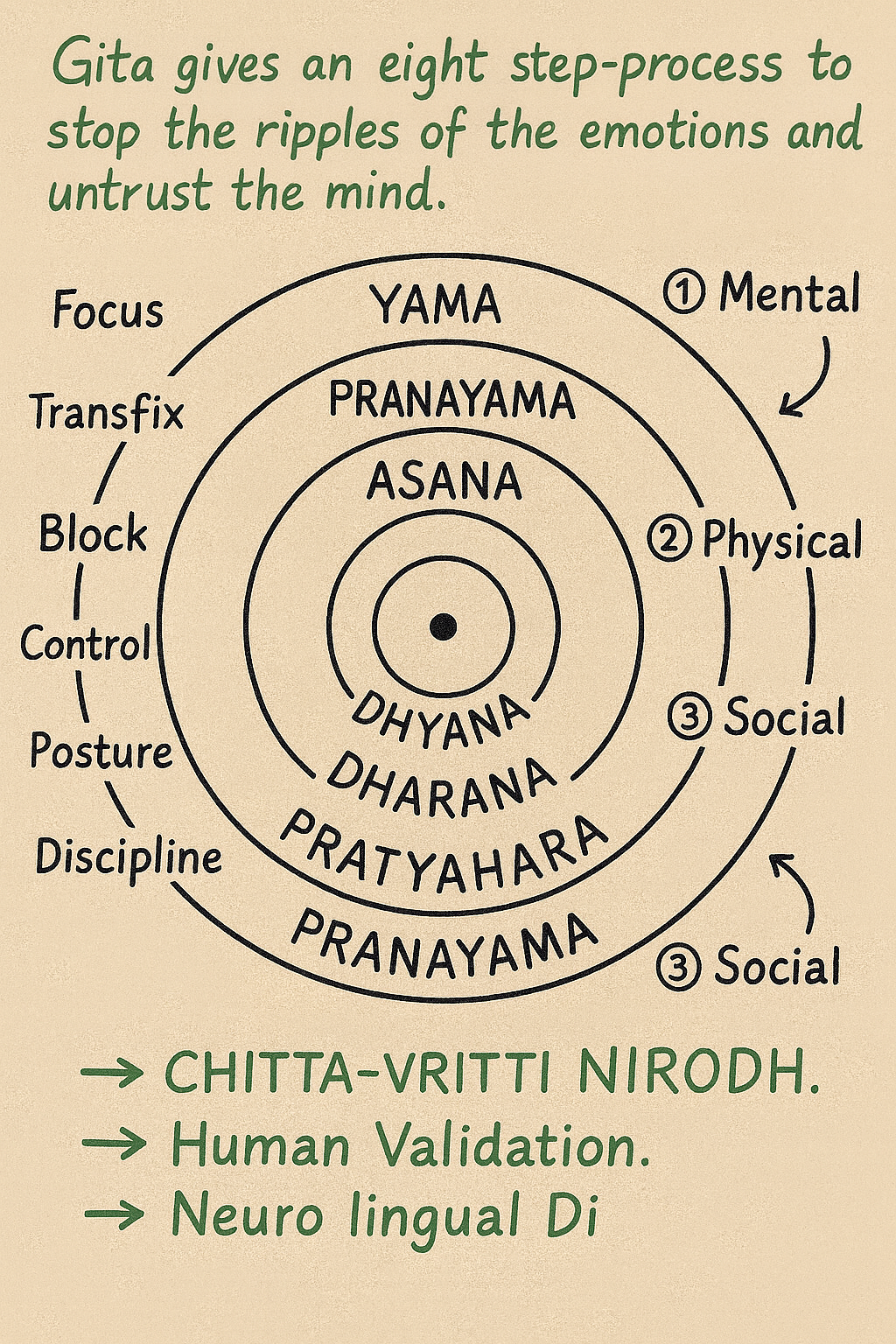
The Gita's eight steps drawn as concentric circles — outer rings to inner stillness
Draw those eight steps as circles.
Outer rings — how you live and move in the world.
Middle rings — how you hold your breath and body.
Inner rings — where attention gathers.
The centre — stillness. The quieting of all mental noise.
Now look at your mandala.
The outermost petals. The middle layers. The rings moving inward. The dot at the centre.
It is the same map.
Every mandala you draw —
you are walking those eight steps.
Not with your mind. With your hand.
This is what the ancient teachers understood.
The hand teaches what the mind forgets.
Svabhava — Your Essential Nature
In Sanskrit, the ancient language of India, there is a word — Svabhava.
Sva means self. Bhava means nature.
Your essential nature. Who you are before the noise of the world settles on you.
Every time you draw a mandala —
the body softens, the mind quietens, the hands find their rhythm —
and your essential nature remembers itself.
Not because you tried to find it.
But because you gave it space.
That is the deepest biology of this practice.
Not just what happens in your body.
But what your body was always trying to return to.
You Don't Need to Understand Any of This
You don't need to know the science.
You don't need to understand the Gita.
You don't need any experience with art.
You just need a pen. A circle. A few quiet minutes.
Let your hand move.
Let your body do what it was always designed to do.
It knows the way back.
The mandala is simply the path.
Join Us
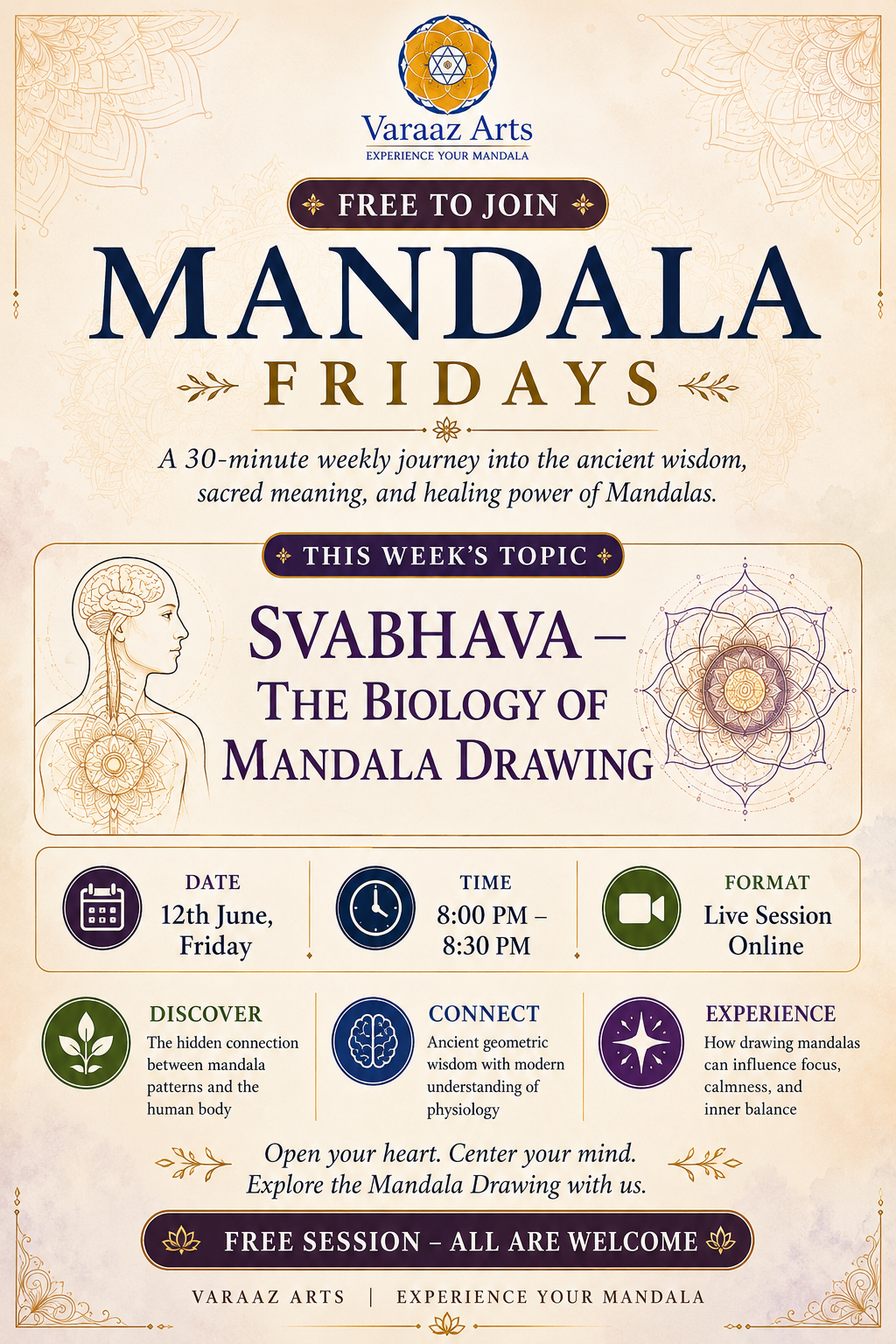
Experience This Live — Mandala Fridays
Every Friday, 8:00 PM – 8:30 PM. Free. Online.
We draw together, explore the wisdom, and come back to centre.
This Friday — June 19 — Mandala as the Living Tool. Our final session of this season.
Join the Session — It's Free